
Regional Science Area
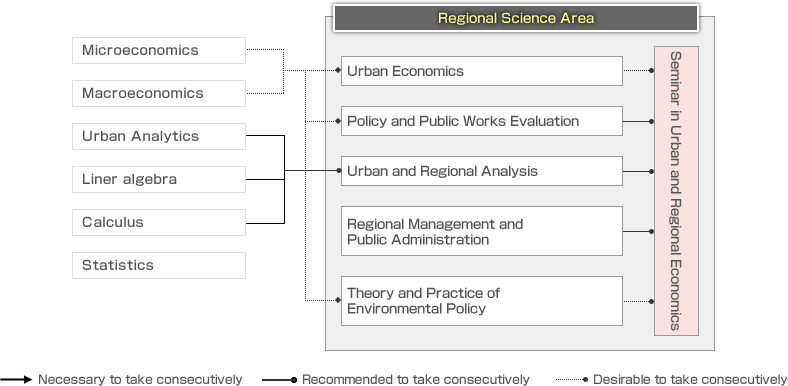
In the Regional Science area, students acquire scientific analysis techniques using mathematical and economic methods for cities, regions, and environments. They learn the basics of the theories needed for policy proposals to address various problems in society. This area consists of the following 5 lecture-based courses and [Seminar in Urban and Regional Economics ]:
| Course name | Course description | Target year/years |
|---|---|---|
| Seminar in Urban and Regional Economics | The students are expected to acquire viewpoints and methods for analyzing policy issues by performing verification analysis using urban, regional, and environmental economic methods, themes, and data. | 3 – 4 |
| Urban Economics | The students will learn the basics of analytical techniques of urban economics and locational theories and acquire knowledge about policies related to intercity, regional, and international trade. | 2 – 4 |
| Regional Management and Public Administration | This course aims to have the students acquire the ability to discuss decision making, implementation, and assessment of public policies and desirable forms of future urban/regional revitalization through case studies of national land planning and housing/urban regional policies based on the recent new global trends related to changes in the style of public policies and their bearers and comparisons with European and American nations. | 2 – 4 |
| Policy and Public Works Evaluation | The present state of policy assessment is explained by focusing on policies related to cities, regions, and national land. Also, concerning infrastructure improving projects, economic analysis (cost-benefit analysis), financial analysis, and project-related finance are discussed. | 2 – 4 (recommended in 2nd-year) |
| Urban and Regional Analysis | If we abstract the city from a certain point of view, we can regard it as a pattern of dots, lines and planes. Therefore, we discuss the mathematical basis for analyzing these patterns from the aspect of urban function. | 2 – 4 |
| Theory and Practice of Environmental Policy * | In this course, students will observe policy measures for environmental conservation and methods for their evaluation mainly from economic perspectives. They will also examine the relationships between various values/disciplines and policy implications to develop diverse perspectives on “environmental problems” and “environmental policies”. Furthermore, they will deepen their understanding of specific environmental issues, such as global warming and waste. | 2 – 4 |
*: Provided by collaborative staff (from the College of International Studies)