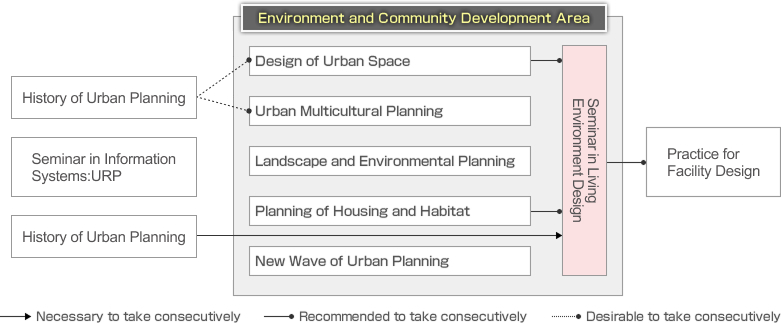

Environment and Community Development Area
The Environment and Community Development area consists of: 5 courses based on lectures to learn practical theories, and study example cases of environmental maintenance and town development, involving cities, houses, and green areas as well as [Seminar in Living Environment Planning] to acquire the thinking, design, and presentation skills needed for specific planning; a total of 6 courses.
| Course name | Course description | Target year |
|---|---|---|
| Seminar in Living Environment Design | This is a practice course aiming to improve the ability to design urban/architectural spaces. The course is designed to have students who have taken subjects related to designing (Seminar for Urban Planning Information, Basic Drawing) during the first 2 years become proficient in methods and techniques for designing detached wooden house and collective housing using basic techniques of designing and drawing that they have acquired. | 3 – 4 |
| Planning of Housing and Habitat | In this lecture, the history of living places in Japan, the effects of postwar social circumstances and changes in lifestyle on urban and agricultural village houses and living environments and contemporary issues are discussed. | 2 – 4 |
| Design of Urban Space | This course gives an overview of trends of architectural/urban designing and presents a variety of the vocabulary necessary for creating attractive spaces. Next, their functional constitution and regulations related to architecture including the Building Standards Act (single unit regulations) are explained. Also, the students will acquire the basic abilities necessary for space designing through designing assignments. | 2 – 4 |
| Landscape and Environmental Planning | Concerning desirable urban/regional planning based primarily on the preservation of the natural environment, historical resources, and open spaces, its historical development, contemporary issues, and directions for the future are discussed systematically by referring to concrete examples./td> | 2 – 4 |
| New Wave of Urban Planning | Planning theories in the 20th century as the theoretical background of modern community development are critically reviewed, and planning processes, participation, planning administration, and planning regulations are discussed. In addition, topics including how modern community development is being implemented, regeneration of downtown and regions of mixed presence and mixed living of urban and agricultural populations, and sustainable environmentally symbiotic community development will be selected and discussed. | 2 – 4 (recommended in 2nd-year) |
| Urban Multicultural Planning* | In the first half of this lecture, we will comprehend the composition of the urban space of Asian countries that seems to be complicated and disordered from historical and local images. In the second half, we will consider what ideas and methods are necessary for multicultural symbiosis urban planning based on the actual conditions of contemporary Asian space propagation to non-Asian cities. | 2 – 4 |
*: Provided by collaborative staff (from the College of International Studies)